2026 YourCause UK CSR Industry Spotlight
Chapter 4 Preview
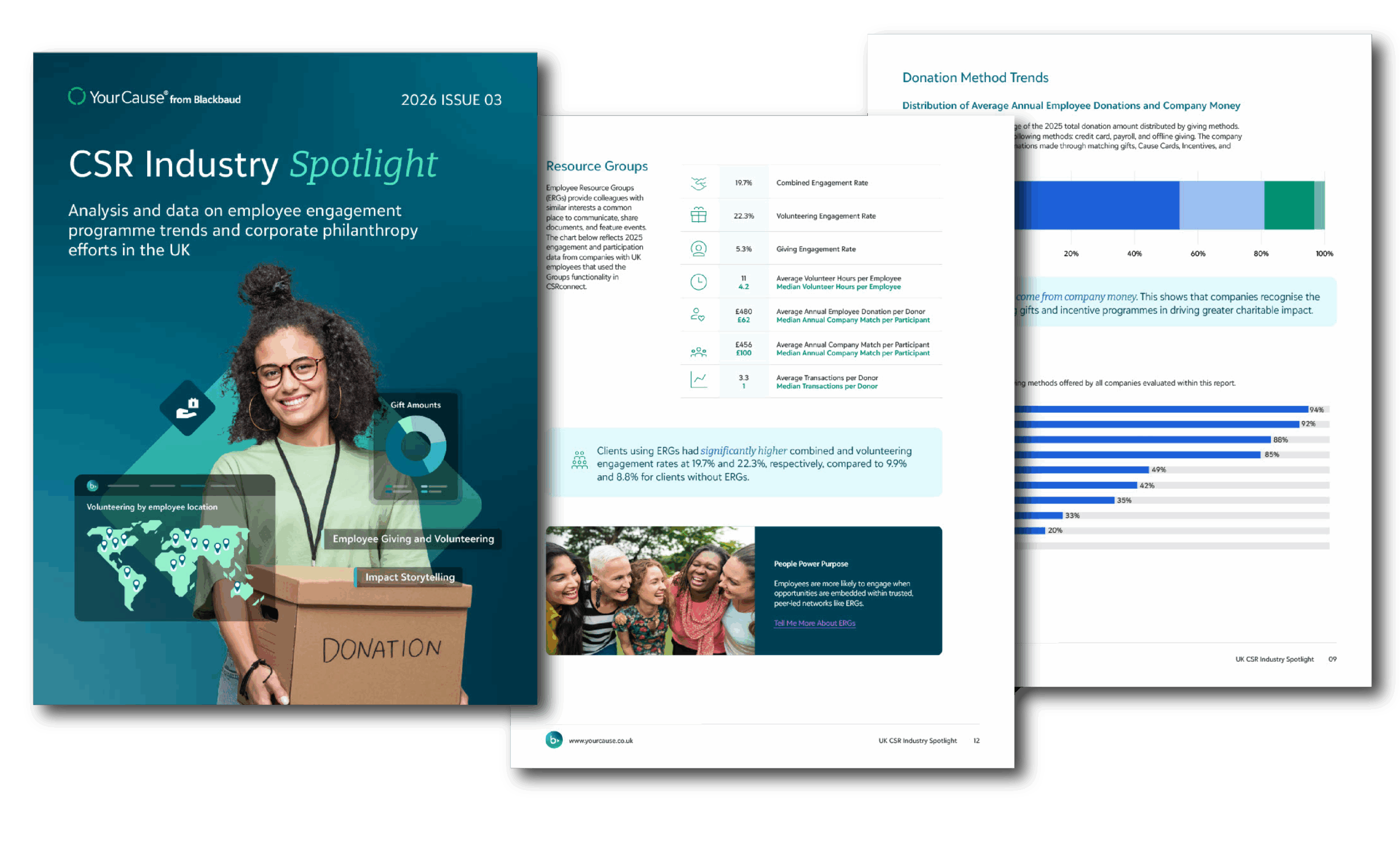
Welcome to the 2026 YourCause UK Industry Spotlight, where we take you inside the latest trends in employee engagement, corporate giving and grantmaking, community involvement, and social responsibility across the UK.
Using real-world data from 125 companies, this report reveals how UK employees are choosing to give back, and how their employers are choosing to support them.
From identifying key shifts in philanthropic behaviour to exploring trends in the programme elements offered to employees, you’ll find all the benchmarking data you need to help build CSR programmes that both fit into your company culture and drive engagement that fuels meaningful impact in the communities you serve.
The observations presented in this report are based on data collected through the YourCause® CSRconnect® and GrantsConnect® platforms. The 2026 edition consolidates data gathered between January and December 2025. All insights are shared with the employee engagement and social responsibility community to ensure they are equipped with the latest research and best practices in the field.
Here is a sample of Chapter 4 of the report:
Programme Engagement Trends
Company Size Data
This section evaluates employee engagement by segmenting companies by their global employee population size. Company size was determined by human resource reports on the number of employee records. Note: this is the size of the company’s workforce globally, not just in the UK.
| Data grouped by workforce size | 1–1,000 | 1,001–5,000 | 5,001–10,000 | 10,001–50,000 | 50,001–100,000 | 100,000+ |
|---|---|---|---|---|---|---|
| Combined Engagement | 31.9% | 44.8% | 16.4% | 17.4% | 3.1% | 10.0% |
| Volunteering Engagement | 28.0% | 33.9% | 14.7% | 17.0% | 17.4% | 5.4% |
| Giving Engagement | 8.5% | 23.3% | 7.8% | 4.2% | 1.5% | 4.9% |
| Average Annual Employee Donation per Donor Median Employee Donation |
£128 £49 |
£677 £107 |
£332 £37 |
£637 £100 |
£439 £80 |
£586 £123 |
| Average Annual Company Match per Participant Median Company Match |
£143 £50 |
£271 £82 |
£282 £50 |
£538 £137 |
£505 £184 |
£707 £149 |
Average Hours per Volunteer Median Hours per Volunteer |
5.9 6 |
9.7 7 |
9.8 4.25 |
10.4 5 |
24.5 7 |
11.3 2.75 |
Percentage of Virtual Volunteer Hours |
1.72% | 2.6% | 19.3% | 5.0% | 4.4% | 10.8% |
Companies under 5,000 employees lead the charge in volunteering and donation engagement for another consecutive year.
Small-mid-sized organisations continue to outperform in volunteering and giving, with combined engagement increasing by 33% since the previous year. Larger enterprises, particularly those with 100,000+ employees, remain the least engaged and saw a slight decline. This gap likely reflects structural differences, as smaller organisations often benefit from clearer visibility, simpler communications, and a stronger sense of local proximity – all of which can make participation feel more personal and more achievable.
To replicate this at scale, larger organisations can focus on localising participation. This means empowering regional teams or ERGs to lead activity, creating location-based opportunities, and tailoring communications to reflect local communities rather than relying on global, one-size-fits-all campaigns. When participation feels relevant, visible, and easy to act on within a local context, engagement can begin to mirror what is seen in smaller organisations
Before diving into the best practices of accounting for restricted funding, it’s important to understand the foundation it’s built on: fund accounting.
Fund accounting is the financial framework that sets social impact organizations apart from for-profit businesses. Instead of focusing on profitability, organizations prioritize mission fulfillment and accountability. Fund accounting enables organizations to segregate resources by purpose—such as general operations, restricted grants, or donor-designated funds—so every dollar is tracked according to its intended use within one system. No army of spreadsheets to track specific grants and programs.
The fund accounting approach is essential because nonprofits, foundations, agencies, and educational institutions often manage multiple revenue streams with unique restrictions. Donors and grantors expect transparency and proof that their contributions are used as promised. Fund accounting systems make this possible by recording transactions within self-balancing funds and ensuring compliance with regulations like FASB’s ASU 958 and GASB Statement No. 34, which requires clear reporting of net assets with and without donor or funder restrictions.